
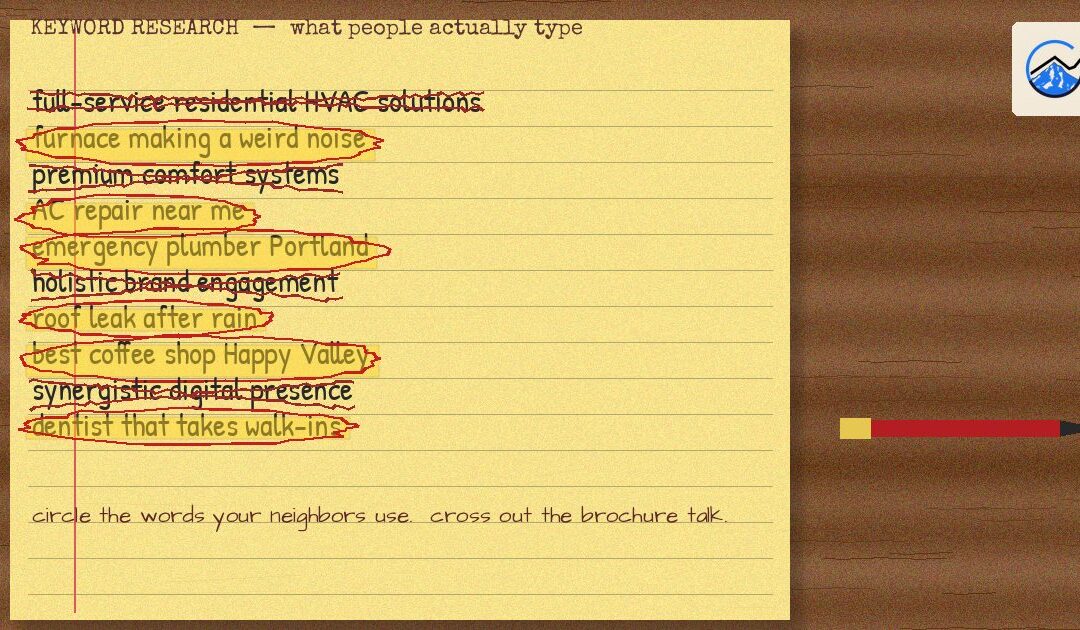
Here’s a fun game. Ask a business owner what they do, and you’ll get something like “full-service residential HVAC solutions.” Ask their customers what they typed into Google, and you’ll get “furnace making weird noise.” Same business. Completely different words. Keyword research is the art of finding out which words your customers actually use, so your website speaks their language instead of your brochure’s.
This is part two of our SEO week. On Monday we covered what SEO is in plain English. Today we get into the part almost everybody skips: figuring out what people are searching for before you write a single word.
What a “keyword” really is
A keyword is just a word or phrase someone types (or says) into a search engine. “Roof repair.” “Roof repair near me.” “How much does it cost to fix a leaking roof.” All keywords. The fancy-sounding term “long-tail keyword” just means a longer, more specific phrase. Fewer people search each one, but the people who do usually know exactly what they want. Which, if you sell that exact thing, is lovely.
Search intent: the part that matters more than the words
Every search has a reason behind it. The commonly used buckets go something like this:
- Informational: “why is my furnace making a clicking noise.” They want an answer, not a sales pitch. Yet.
- Navigational: they’re looking for a specific business or site. “Joe’s Plumbing phone number.” If you’re Joe, you’d better show up.
- Commercial: “best furnace brands” or “furnace repair reviews.” They’re comparing options.
- Transactional and local: “furnace repair near me” or “emergency plumber [city].” Wallet is out. Phone is in hand.
The trick is matching the page to the intent. If someone wants a quick answer and lands on a page that’s basically a giant “BUY NOW” button, they leave. If someone is ready to hire and lands on a 3,000-word history of plumbing, they also leave, possibly while muttering.
Free ways to find out what people search
You do not need an expensive tool to get started. Some publicly available options:
- Google autocomplete: start typing your service into Google and look at the suggestions. Those come from real search behavior. It’s like eavesdropping, but legal.
- “People also ask” boxes: those expandable questions in search results are a free list of things people want to know. Each one is a potential FAQ or blog topic.
- Related searches: scroll to the bottom of the results page. More ideas, zero dollars.
- Google Search Console: if your site is connected, the Performance report shows the actual search queries that brought up your site. This is your own data, which beats guessing every time.
- Google Ads Keyword Planner: it’s part of a Google Ads account and gives rough search volume ranges. Even if you never run an ad, it can be useful for research.
- Your own phone and inbox: how do customers describe their problem when they call or email you? Write that down. Those words are gold, and nobody else has them.
How local businesses should think about keywords
For a business that serves a specific area, keywords usually come in a pattern: service + place, or service + “near me.” A few practical basics:
- Give each main service its own page. One page trying to rank for twelve unrelated services is like one employee answering twelve phones.
- Be honest about where you work. Pages about the areas you actually serve help people (and search engines) understand your reach. Pages for towns you’ve never set foot in? Not so much.
- Use the words naturally. Put your main phrase in the page title, the main heading, and the copy where it makes sense. Then stop. Repeating “best plumber Portland” eleven times in a paragraph is how you write something nobody, human or robot, wants to read.
- Answer the real questions. Costs (honestly, in ranges if you can), timelines, what to expect, what to do in an emergency. Those informational searches often turn into customers later.
- Keep your Google Business Profile in sync. Your categories and services there should match what your site says. We covered that in our Google Business Profile checklist and in how to build a strong local service profile on Google.
Mistakes we see all the time
- Chasing the biggest number. A huge-volume, super-broad keyword sounds exciting until you realize most of those searchers aren’t your customers.
- Using industry jargon nobody searches. If you call it “fenestration” and your customers call it “windows,” go with windows.
- Writing two pages for the same keyword. They end up competing with each other. Sibling rivalry, but for web pages.
- Doing it once and never looking again. Language changes, services change, and so do the questions people ask. Peek at your Search Console queries every so often.
A 20-minute keyword exercise you can do today
- Write down your top three services in the words your customers use.
- Type each one into Google and note the autocomplete suggestions and the “People also ask” questions.
- Add the areas you actually serve and see what comes up.
- Check whether your site has a clear page for each service and answers at least a few of those questions.
- Make a short list of gaps. That’s your to-do list.
Want a head start? Grab our free local SEO checklist, or ask for a free SEO audit and let someone else squint at the spreadsheet.
How Three 7 Projects can help
Figuring out what your customers search for, and then building pages that actually answer them, is a big part of our search engine optimization service. We work with businesses across the Portland metro, including Portland, Happy Valley, Gresham, Lake Oswego, Tigard and Vancouver, WA. The full list lives on our service areas page.
Why we want to help
Honestly? Because it drives us a little nuts when a great local business is invisible online just because its website describes things in words nobody types. You’re good at what you do. Your website should say so in plain language your neighbors actually use. We like helping make that happen, and we like working with people who care about their customers.
How to become part of the 37 Project family
No secret handshake. You reach out, we have a real conversation about your business and what you want from search, and if it’s a good fit, we work together. That’s it. Call 503-799-0407 or drop us a note on the contact page, and tell us what you’re working on. Bonus points if you tell us the weirdest thing a customer ever typed to find you.