
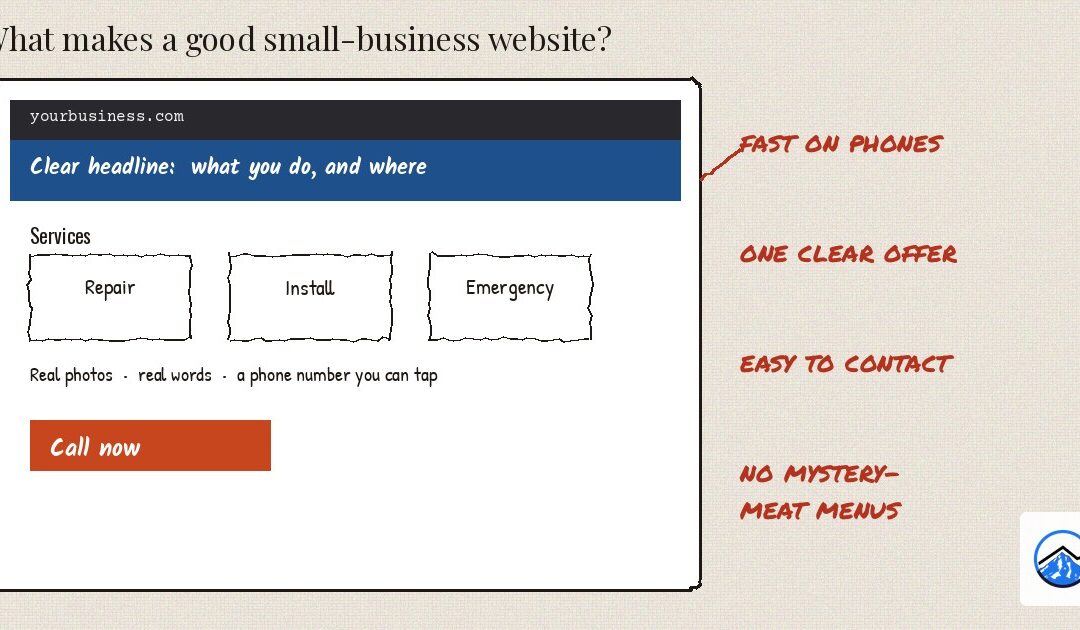
Quick test. Pull up your own website on your phone, pretend you’ve never heard of your business, and try to answer three questions in ten seconds: What do they do? Where do they do it? How do I reach them? If you found yourself pinching, zooming, scrolling past a stock photo of a handshake, and squinting at a “Welcome to our website!” headline, congratulations. You’ve just experienced what a lot of your potential customers experience. A good small business website isn’t about being fancy. It’s about helping a stranger figure out, fast, whether you’re the right call.
This week on the blog is all about website design and development. Today we’re starting with the big picture: what a website is actually for, what it needs, and the mistakes that quietly cost businesses calls. (If speed is your main headache, we already wrote about why your website is slow on phones and what to fix first.)
Design vs. development, in plain English
People use these words like they’re the same thing. They’re related, like cousins who show up to the same barbecue.
- Web design is how the site looks and feels: layout, colors, fonts, images, and how easy it is to find things. It’s the part your eyes judge in about a second.
- Web development is how the site works: the code, the content management system (WordPress, for example), forms, page speed, security, and making sure everything behaves on phones, tablets and desktops.
A beautiful site that breaks on a phone is a problem. A technically perfect site that looks like a 2006 tax form is also a problem. You need both.
What your website is actually for
For most local businesses, the website has a short job description:
- Explain what you do in words customers use, not words from your brochure.
- Show where you do it, so people in your area know you serve them.
- Build trust with real photos, real information and real ways to reach you.
- Get someone to take the next step: call, fill out a form, book, or visit.
That’s it. Every page, button and photo should help with at least one of those. If something doesn’t, it’s decoration. Decoration is fine in moderation, like sprinkles.
The basics every small business site needs
- A clear headline above the fold. “Plumbing repair and water heater installation in [your area]” beats “Excellence in Every Drop” every single time. Clever is nice. Clear pays the bills.
- A phone number you can tap. On mobile, a phone number should be a clickable link. If people have to copy and paste it, some of them won’t.
- A simple contact form. Ask for what you actually need. Every extra field is another chance for someone to give up.
- A page for each main service. One page that lists twelve services in a single paragraph helps nobody, including search engines.
- Your service area. Say where you work. Honestly. If you serve three towns, say three towns.
- Real photos when you can. Your team, your work, your space. Stock photos of smiling people pointing at laptops are the elevator music of the internet.
- Mobile-friendly layout. Google has said for years that it primarily uses the mobile version of a site for indexing and ranking, and a lot of your visitors are on phones anyway. Design for thumbs.
- Security basics. An HTTPS certificate (the little padlock), updated software and plugins, and backups. Boring? Yes. Less boring than getting hacked.
- Basic accessibility. Readable text sizes, enough color contrast, descriptive alt text on images, and buttons that are big enough to tap. It’s the right thing to do, and it makes the site better for everyone.
- Analytics. Something like Google Analytics so you know whether people are calling, filling out forms, or bouncing faster than a toddler on a trampoline.
How your website and SEO fit together
Last week we covered what SEO is in plain English and how to find the words your customers actually search. Your website is where all of that lives. Page titles, headings, clear service pages, internal links, fast loading and a clean structure all help search engines understand what you do. A website and SEO aren’t two separate projects so much as one project wearing two hats.
Mistakes that quietly cost you calls
- The mystery-meat homepage. Lots of vibes, no explanation. Visitors shouldn’t have to solve a riddle to learn you fix roofs.
- Hiding the phone number in tiny gray text at the very bottom of the page, like it’s witness protection.
- Auto-playing videos and pop-ups that appear before anyone has read a single sentence.
- Old information. Wrong hours, a service you stopped offering, a “2019 Holiday Special” banner. People notice.
- Forms that go nowhere. Test your contact form. Then test it again. A form that silently fails is worse than no form at all.
- Building it and forgetting it. A website isn’t a billboard you put up once. Software needs updates, content needs refreshing, and things break.
A 15-minute website check you can do today
- Open your homepage on your phone. Can you tell what you do and where within a few seconds?
- Tap your phone number. Does it start a call?
- Submit your own contact form. Did the message actually arrive?
- Check your hours, address and services. Are they current everywhere?
- Look for the padlock in the browser bar. If it’s missing, put HTTPS on the list.
- Click through your main menu. Anything broken, empty or embarrassing? Write it down.
Want a second set of eyes? Request a free SEO audit, or grab our free local SEO checklist to see how your site and your online presence stack up.
How Three 7 Projects can help
Designing and building websites that are clear, mobile-friendly and easy to update is exactly what our website design and development service is for. We work with businesses across the Portland metro, including Portland, Happy Valley, Beaverton, Hillsboro, Oregon City and Vancouver, WA. You can see the full list on our service areas page.
Why we want to help
Because your website is often the first conversation a customer has with you, and you’re not even in the room. It bugs us when a business that’s great in person shows up online as a confusing, slow, outdated page. You’ve earned a website that makes a good first impression for you while you’re busy doing the actual work. We like building that, and we like working with people who take care of their customers.
How to become part of the 37 Project family
There’s no velvet rope. You reach out, we have a real conversation about your business and what you want your website to do, and if it’s a good fit, we work together. That’s the whole thing. Call 503-799-0407 or send us a note on the contact page. Bonus points if you tell us the one thing about your current website that makes you wince.