
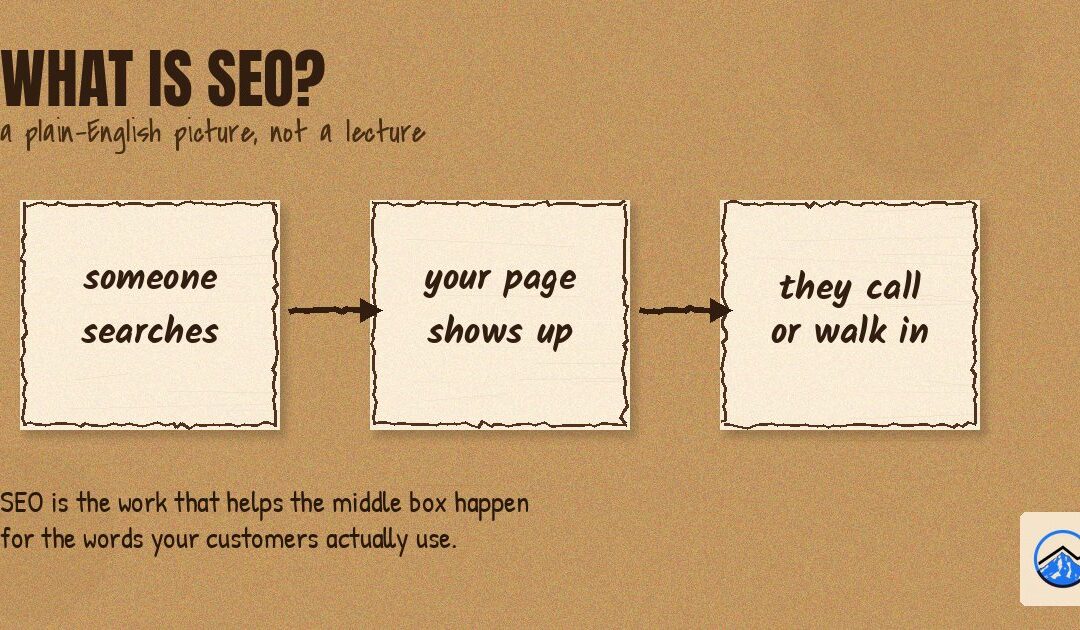
Let’s start with a confession: “SEO” is one of those words everybody nods at in meetings and nobody wants to admit they only half understand. So here’s the plain version. Search engine optimization is the work of making it easy for Google (and other search engines) to understand what your business does, where you do it, and why someone should pick you. That’s it. No wizard hat required.
This is week one of our SEO series, and this first post is the “what even is this” edition. Grab coffee. Or whatever you drink while pretending you have time to read blog posts.
How search engines actually work (the short, non-boring version)
Search engines do three jobs, in roughly this order:
- Crawling: automated programs follow links around the web and find pages. If nothing links to your page and it isn’t in your sitemap, it may as well be a note in a bottle.
- Indexing: the search engine reads the page, tries to figure out what it’s about, and stores it. Not every page that gets crawled gets indexed, which is a fun surprise for everyone.
- Ranking: when someone searches, the engine picks from what it has stored and orders results by what it thinks is most helpful for that person, that question and that place.
Nobody outside Google gets the full recipe for ranking, and anyone who tells you otherwise is selling something. What Google does publish is plenty: make helpful pages written for people, keep the site technically healthy, and be clear and honest about who you are.
The main pieces of SEO
1. On-page SEO: what’s on the page
This covers the stuff a visitor (and a search engine) can read. A clear page title, a descriptive heading, content that actually answers the question someone searched, sensible subheadings, and descriptive image alt text. If your page about water heater repair never says “water heater repair,” that’s a you problem, not a Google problem.
2. Technical SEO: can the site be crawled and used
Does the site load reasonably fast on a phone? Is it on HTTPS? Does it have a sitemap? Are there broken links or pages accidentally set to “noindex” (the digital equivalent of a “do not enter” sign)? Technical issues are the unglamorous plumbing of SEO, and when they’re broken, nothing else matters much.
3. Local SEO: being found near you
If you serve customers in a specific area, local SEO is a big deal. It’s how businesses show up in the map results and in searches like “plumber near me.” The basics are publicly documented: a complete and accurate Google Business Profile, consistent name, address and phone number across the web, real reviews from real customers, and website pages that clearly say what you do and which areas you serve. We wrote a longer walkthrough in our Google Business Profile checklist for Portland-area businesses, and our local SEO checklist is free if you want something to tick off.
4. Content and links: being worth talking about
Helpful content earns attention, and attention (links from other legitimate sites, mentions, reviews) is a signal that others find you useful. Buying a pile of sketchy links is the fast food of SEO: tempting, quick, and you’ll regret it later.
A few myths we’d love to retire
- “SEO is a one-time thing.” Websites change, competitors change, search results change. It’s maintenance, not a tattoo.
- “Just stuff in more keywords.” Please don’t. Write like a human talking to another human.
- “Somebody can guarantee you the number one spot.” No one controls Google. If a pitch promises that, run, don’t walk.
- “SEO is only for big companies.” Local searches are where small businesses often have the best shot, because the competition is about people nearby, not the whole planet.
A simple self-check you can do today
- Search your own business name and your main service plus your city. What shows up?
- Open your site on your phone. Is it readable and quick? Can you tap to call?
- Look at your Google Business Profile. Are the hours, categories and phone number correct?
- Check that each service you offer has its own page that explains it clearly.
- Ask: if I knew nothing about us, would this site tell me what you do and where?
If you’d rather have somebody else take a look, we offer a free SEO audit.
How Three 7 Projects can help with SEO
SEO is one of the core things we do. If you want to see what’s included, our search engine optimization service page lays it out, and we work with businesses around the Portland metro, from Portland and Happy Valley (our home base) to Beaverton and Hillsboro, plus Southwest Washington. You can see the full list on our service areas page.
Why we want to help
Because it’s frustrating to watch a good local business get buried online just because nobody explained how any of this works. Small businesses hold communities together, and we like being part of that. Plus, it’s a lot more fun to work with people we actually want to hang out with.
How to become part of the 37 Project family
It’s refreshingly simple. You reach out, we have a conversation about your business and what you’re hoping to get out of search, and if it feels like a good fit, we work together. No jargon wall, no pressure. Call us at 503-799-0407 or send us a message on our contact page, and tell us what you’re working on.
Next up in the series: more SEO, because we’re nowhere near done.